
At the end of a sun-like star’s life, it forms a planetary nebula—an expanding cloud of gas that can span light-years across. These nebulae last around 20,000 to 30,000 years before dispersing into the interstellar medium. During this slow death, elements such as carbon and oxygen are released—elements that later become part of new stars, planets, and potentially life itself. In fact, the atoms that make up our own bodies contain some of the same elements that are found in stars, telling us that we too came from the stars.
I’m a little obsessed with space these days, because like many people, I followed the Artemis II mission and watched four astronauts travel the furthest away from Earth, the first time in 50 years that we’ve sent people beyond low-Earth orbit. I grew up hearing the stories, but I’ve never been able to follow it with my own eyes and ears, experiencing the joy of a space mission against the ever present reality that it could end in death. There is something about us loving high stakes. Pages in a history book can not stir our emotions in the same way. It has to be felt in real time.
A few years ago, I took my children to the Kennedy Space Center, where we learned about Apollo, saw the NASA launch pads, and experienced a shuttle launch simulator. We’ve gone on a couple tours of the Jet Propulsion Lab in Pasadena, CA, observing Mission Control—a room full of buttons and screens—designed for deep space communication. And my oldest son—a big fan of NASA and author Andy Weir—had us watch Project Hail last month. I was ready for the joy of following the crew of Artemis II—and all of the invisible people behind the scenes making it happen— reading their stories, listening to their Spotify wake-up music, following their trajectory and marveling at the capacity of human beings to push themselves outside of their comfort zones and reach for something bigger than themselves for the betterment of humanity. In these dismal times, a space mission feels optimistic.
Something that really stood out to me was how many of the astronauts expressed an awe about the beautiful Earth they saw from another perspective, spinning in a vacuum of darkness, fragile, a miraculous oasis of life. A reminder that in the grand scheme of the universe, we are so lucky to even be here.
In 10 days, my husband Kenneth will have been dead for 10 years. This number does not feel possible. I could have never imagined in a million years during those early days of raw shock and grief that I could have survived 10 years after that tragic day. When Kenneth died, we were in the middle of the diaper years with a 13-month-old, a 3-year-old, and a 6-year-old. I’ve spent more years having a relationship with his absence than I did with him alive. For a decade, I have had to reconcile a spectrum of emotions: sadness, anger, loneliness, regret, shame, anxiety, guilt, fear, confusion. And also, joy. Can you feel joy again once you are forced into a life you did not choose?
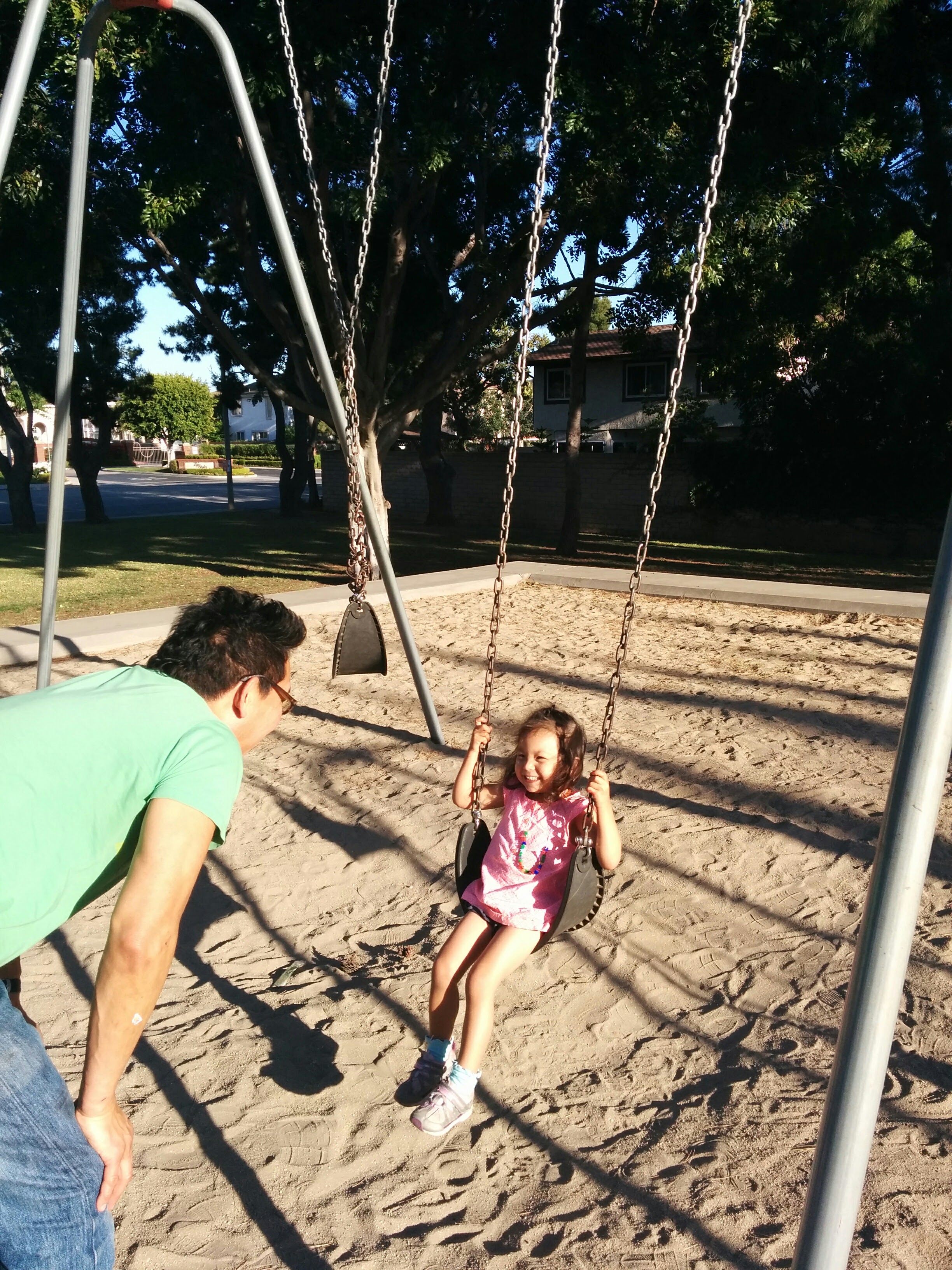
Two weeks ago, our middle child became a teenager. I remember the last birthday we spent together as a family of five, exactly two weeks before the fateful day. My body remembers the details of our final weeks, a desperate attempt to not lose the memories into the vastness of time. Eloise got a Princess Anna make-over at Downtown Disney and held her Daddy’s hand as we went to dinner at Island’s. A couple days before he died, we all went to the mall. Eloise smuggled a bottle of nail polish into her carseat, which we figured out halfway during the drive when the mysterious odor baffled us into further inquiry. I remember both of us laughing, marveling at her spunkiness. I miss that the most—being mutually amused about our children in the way only both parents could share. We went to a little park near the mall before we shopped, where I snapped a photo of Kenneth grinning proudly at her as he pushed her on the swings. Then we went to Nordstrom, where Eloise buzzed with excitement around the shoe section, trying on shoes she didn’t want to ever take off, and her father absolutely could not say no to the pink ankle boots she wanted to buy. And then, two weeks to the day later, he was gone.
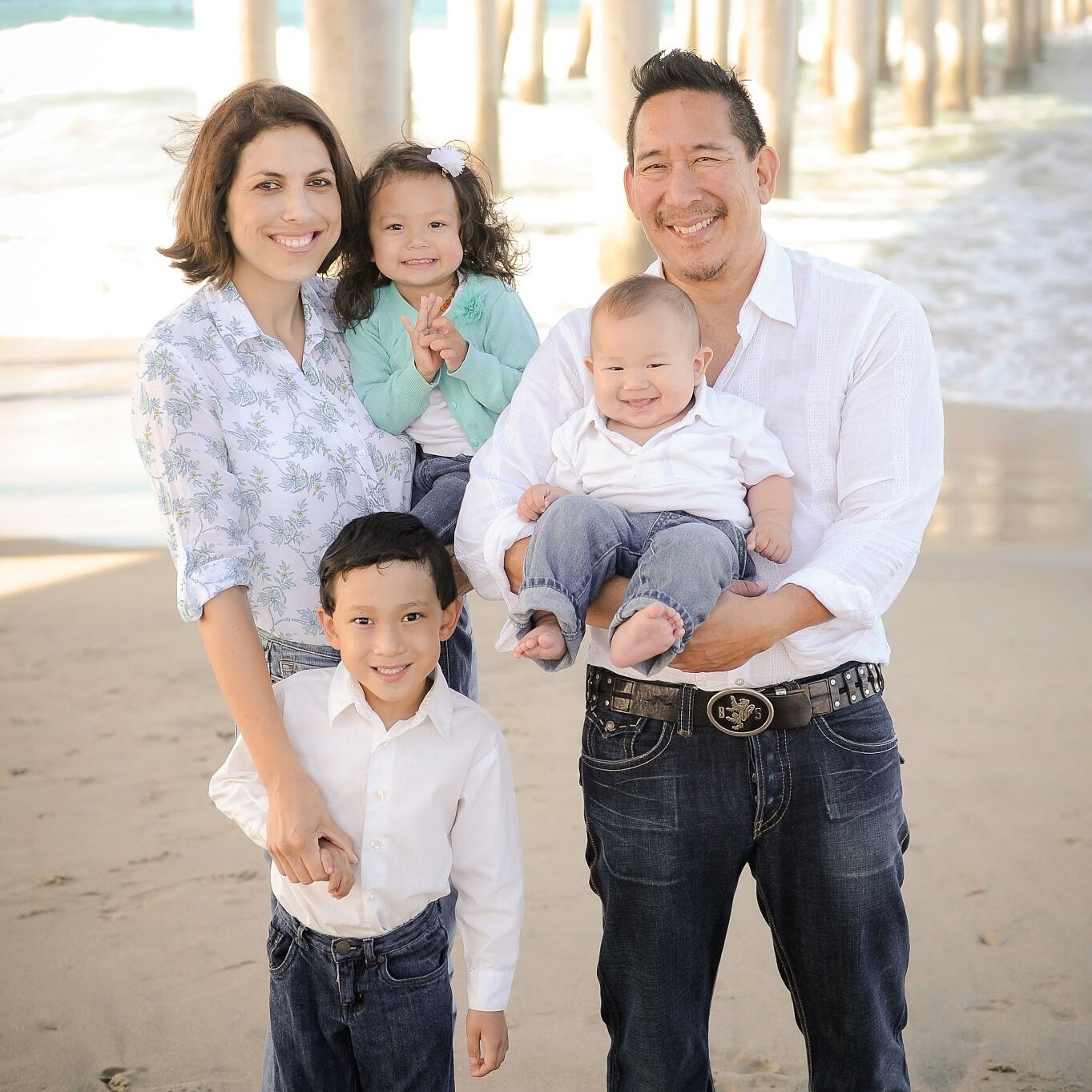
Eloise celebrated turning 13 this year by getting some of her hair dyed blue and another piercing on each ear, long past the stage of princess dresses and everything pink. I often wonder what her dad would think. When she was born, she was an ugly baby. I know you are not supposed to say that, but she was. She used to projectile spit up after every meal. She had a sour disposition, cranky, jaundiced. Kenneth used to tell me not to worry. If she was ugly—which is certainly hard for women in this society, according to him—we would work on her personality. That a great personality would make up for being ugly. By her 2nd birthday, we took her for a photo shoot and I remember him ordering every pose offered to us. The framed collage is still on the wall in our hallway. This was the moment when he formally declared that he didn’t think she would actually be ugly. That she was, in fact, cute. It seems like such a silly thing in hindsight to fret over, but then again, it never crossed his mind that her 3rd birthday would be the last he would see. If he were here today, I know he would recognize that she is so much more than cute. She’s creative and athletic. She’s a hard worker. Quiet and deep thinking. Reflective, loyal, kind. I feel like I’ve spent the last 10 years silently apologizing to her for not getting to be the daddy’s girl that she was through my own devotion to her. I try to extra support her and her endeavors—as well as her brothers’— which has been my number one priority, always. I know their father would have wanted that. I do not believe in an afterlife, but it is fun to imagine his sister, when she passed two years ago, reporting back to him. I like to imagine her reassuring him that the kids are taken care of, and that they will be okay. More than okay.
One of the astronauts—Reid Wiseman—lost his wife 6 years ago to cancer. It was great to see a widower representing our land of misfits—broken people still reaching for meaning and joy despite the pain and suffering. On the Artemis II mission, the crew named a bright spot on the moon after his late wife, Carroll. I am so glad the world got to see that even 6 years out, his late wife still meant the universe to him and that her absence is still mourned. Time doesn’t erase. The best it can do is heal.
Commander Wiseman was interviewed about what it is like continuing his career and raising their two daughters on his own—certainly a major feat in his demanding career—and he said it was his greatest challenge being an only parent and also the most rewarding. Before the mission, he had to talk to his daughters about his will and what would happen if he didn’t make it home alive. For us only parents, this is a constant reality. When I go to my annual health exams, it is peace of mind that I can still optimize my ability to continue providing for my children as an only parent.
While 10 years of grief has certainly been spent missing my husband and grieving the life we had, a lot of it has also been grieving the traditional family. Grieving my co-parent, carrying this tremendous boulder on my own back in a way I never expected. Captaining this ship knowing it has a gaping hole, and finding direction even when everything feels upside down.
I did not get to finish the little kids chapter of our lives with Kenneth—our oldest was in kindergarten when he passed. I now have two teenagers in the house, and I don’t even remember daydreaming with Kenneth what our lives would look like at this stage. It seemed so far off into the distant horizon. I remember older mothers remarking that if I thought raising babies and toddlers was hard, just wait for what’s to come. I used to think: I’m sleep-deprived and physically exhausted—how could it get any harder? The truth is, I’m not sure if it is harder in an apples to apples sense, but it certainly hasn’t gotten any easier. I think it has gotten more complicated, busier, and definitely more expensive. I do not know what Kenneth would say about the activities we do, how I handle certain situations, or anything about the way I move through each day as a parent of teens. All I can do is make decisions based on what I predict he would say, and that’s the strange, one-dimensional feeling of having children with someone who is dead. Co-parenting with the spirit of a person. It can be a source of inspiration and direction, but certainly not useful for parent teacher conferences or teaching your kid how to drive or setting up their first checking accounts or driving them to their soccer games or trying to make them feel better after a disastrous event in their lives.
But I can’t say that he isn’t here either. I know now that a person transcends their physical form.
I feel him in every fiber of my being, as if my atoms were forged from the same elements as his—just like the remnants of a dying star giving way to new life. He’s in our memories, sure. But it’s a spirit—maybe a force—I can’t quite capture with words. It’s a whisper of reassurance whenever I doubt myself. It’s the way I softened in my own classroom as a teacher after he passed, and 10 years later, here I am, accepting late work and late work for late work and not the uptight teacher who I used to be. I think it is because of him that I became a teacher who prioritizes the bigger picture now versus keeping tabs on student compliance. He taught me that being a teacher is more than calculating points, but that it is a human experience, not even measured by traditional grades.
I’ve seen him still in this world when his kind former students left me comments earlier this year, students from way back from the beginning of his career when he taught junior high, and how they still remembered him and his impact. He was in the former student who is now a nurse, who I met at the end of my dermatology exam when she quietly told me she was sorry for my loss, and that he was a great teacher. It’s Eloise’s history teacher who shared that he knew Kenneth way back when coaching wrestling. The little notes in his handwriting I still find in the garage. I feel him in politics every time I feel guilty for not doing more, because he would have done more. I need to do more. He lives on in my oldest, the facial expressions he makes, his approach to life, the color of his hair, the way he loves his father’s Magic the Gathering cards he found in the 7th grade, an inheritance only a fatherless child would appreciate. Kenneth is in our youngest child, his wild side, big emotions and feelings, the way he looks wearing glasses, even the same birthmark on their backs. I believe he is in Eloise’s confidence—the way she knows she is fiercely loved—even when society would put a label on a fatherless daughter. Because she is not fatherless. He is always here.
I was at a pool last summer. It had been a difficult start to a vacation. I was in Hawaii with a kid with a broken leg. Another kid had his arm in a splint, facing possible surgery. I lost a wallet on the airplane. We almost got scammed at the rental car place. And traveling with teens, which is in many ways harder than when I used to travel with babies and toddlers solo.
The kids splashed in the pool together. I went into the hot tub, taking in a moment of peace and feeling grateful for the beautiful purple-grey sky at sunset, the warm island breeze, health, and being alive.
A guy in the hot tub said hello. I said hello back, although I was hoping the conversation would end there and I could have a quiet moment. It had been such a shit-show leading up to this day. The kids would be fighting before I knew it and I craved a quiet second to myself.
“Where are you from?” the man asked.
I knew my quiet moment was over.
I told him Southern California. He said he was too.
He told me they were there for his daughter’s high school graduation.
How nice. That’s great. Wonderful. An exchange of niceties.
“How many kids do you have?” he asked.
“Three.”
“Same,” he said. “Three daughters. It has been rough for them.”
I knew the direction this was going. I somehow elicit people’s confessions. Sad stories find me. Maybe they can sense the invisible thunderclouds hanging over my head, the sadness coursing through my veins even when I look happy, and then they know it is safe to disclose their own stories. I saw emotion pooling in his eyes and I braced myself.
“Unfortunately, my wife died 6 months ago. It has been very hard.”
“I’m sorry for your loss,” I said. We say these words even when we know how hollow they are. It’s like setting your email to an automatic responder. But also, there is a fine line with strangers and their vulnerabilities, so I go with the automatic responder even when I know how cheap it is. I have to assess the conversation and decide where I want it to go. In the early days of my grief, it was different. I would have blurted it out to anyone. It would have been my duty to make others feel even a speck of the scorching pain I felt. But now, most people on the kids’ sports teams wouldn’t even know the reason why their dad is never there.
I listened as the man explained how his wife was given a four month prognosis, but lived for four years. Six months of new grief needs somewhere to bubble over into. It needs to be repeated over and over again until it dries out and shrivels up into something manageable to carry day-to-day. But the remnants of grief is more like nuclear waste in the sense that you aren’t completely getting rid of it in your lifetime. It’s inside of you forever.
I waited for a pause in his story. Then I dropped my own bomb.
“Unfortunately, I’m in that club too. My husband died when my kids were 1, 3 and 6.”
His eyes grew big. I’m good at doing this now. Lowering the boom and acting as casual as a discussion about the weather. I saw him look toward the pool, noticing my teens and the youngest splashing around. I knew he was doing the math. The math doesn’t seem possible, how someone my age could have been widowed for so long with children their ages.
Finally, after a long pause, he asked the question so many people in this awful club wanted to know.
“Does it ever get any easier?”
I heard somewhere that not knowing how life began and what happens after it ends fosters human creativity. To me, this boils down to our ability to choose our response to the causes and conditions life presents, forging our stories while knowing that it hangs in the precarious balance of the unknown about what happens next and when it will all be over. An unrepeatable experience we often take for granted until it is too late.
Does it get any easier?
The weight of it doesn’t get any lighter.
But you get stronger and carry it with less effort, and in that sense, yes, it gets easier.
Does it go away?
No.
Do you still get sad?
Yes.
Do you cry every day?
No.
Do you cry sometimes?
Yes.
Will you experience joy again?
Absolutely.
Somehow you’re able to find it even when the world keeps giving you a million reasons to hate everything. This kind of grief-joy comes from knowing what it feels like to lose it all. I call it perspective-joy, and it isn’t anything I could have experienced before tragedy.
Some day you will realize it was the most precious gift you were ever given.
In the Artemis II mission, I felt like I was witnessing the best part of our humanity—intelligence, collaboration, curiosity, joy, wonder, shared leadership. A mutual drive and purpose to serve and better humanity. Christina Koch, one of the astronauts on board, said at a press conference after their landing, “A crew is inescapably, beautifully, dutifully linked. Planet Earth, you are a crew.”
I think 10 years of grief has taught me that we are foolishly misled to think we are bound to just a partner, or our kids, or even our immediate family. We foolishly think what we have will last forever. Or even that we are owed something. We operate in silos, wearing our blinders and missing the entire point.
Instead we are part of something bigger in this weird, miraculous, unexplainable experience in the here and now on a life oasis called Earth. No promises and no guarantees. We are made up of the elements of everything that came before us and we are inextricably linked to everyone who will come after us.
Artemis II Crew member Jeremy Hansen said during the mission, “…we live on a fragile planet in the vacuum and the void of space…we’re very fortunate to live on planet Earth…our purpose on the planet as humans is to find joy…and lifting each other up by creating solutions together instead of destroying.”
Ten years of grief has convinced me that when someone in our crew falls, it is our duty to keep showing up each day as the best version of ourselves. I have been given the opportunity to be alive. To experience all that humanity has to offer in this life oasis. With that perspective,I feel like the only response is gratitude. There is so much to be thankful for.
Thank you, Kenneth, for being the very best teacher I ever had. I will carry you until the end of my mission, to infinity and beyond.

 Teresa Shimogawa
followed u i become a solo co parent in 2019 u been my inspiration n comfort. Thank u for sharing
LikeLiked by 1 person
Beautifully written, straight from the heart. Thank you. ♥️
LikeLike
I read this entire post, twice, with my hand unintentionally over my heart the entire time. I lost my brother, only sibling, 10 years ago, not the same, but exactly the same in so many ways. I too watched the Artemis II mission with awe and wonder. Thank you for your always wonderful posts.
LikeLike
This was a tough read, but a great one. I am coming up on 10 years as on only parent in November. I have been following you since the beginning. Your words are so true and poignant. I read this twice as well. Thank you for opening up about something so raw and incredibly heavy, but also beautiful and joyous. You are an inspiration to me. Thank you for writing these beautiful words.
LikeLike