One day, I drove into my neighborhood and saw signs pointing to an estate sale. I’m nosy, so I followed the signs. Cars crowded around the house behind me, and I knew it was my neighbor’s home. My breath caught in my chest for a second.
I saw an unfamiliar person walking with the gait of a man who just scored a good deal, a pile of wood under his arm. Other people were entering the open gate. Some were leaving, a frenzy of scavengers picking apart my neighbor’s home!
I just saw my neighbor the week before. I always saw him, tinkering with his tools, puttering around the house. I did not know his name. All I knew was what I learned from my now deceased in-laws, that the man was half-Japanese, a detail notable probably only to another Japanese family in what was lily white Orange County at the time. But I never heard the man from my backyard. I did not know what his voice sounded like. Everything I knew was cobbled together from my observations over the years. He was quiet, lived alone, and seemed active. And now, apparently, he is gone.
The sight of the people-vultures picking apart his home stirred a reaction in me.
I did not know his name, but I mourned his loss, the impermanence of it all, the slow turning of life, the making way for something new. Another one gone.
His next door neighbor—a hoarder—had died a few years before. I knew his name was Ken, like my husband, because he had come around before to talk to us about our neighbor across the street, who apparently he had had a decades long feud with, and I’m not one to turn down the local tea. If you look at Google maps, there are aerial views of Ken’s house, a backyard filled with junk, a front yard cluttered with rundown boats and ancient trucks and rusty tools, all of this visible even from the sky. The rumor was he had a hole in his bathroom floor that he never got around to fixing. When Ken died, his son had a garage sale, and my youngest bought an old camera from them. It did not work, but my son had fun pretending with it for months, until one of my cleaning purges and I threw it away, long after its parts had been scattered throughout his room and our house. I tried to imagine Ken, someone who I had only seen puttering around junk piles in his dirty overalls, having interesting hobbies. A photographer. A life. There was a story there. It’s so strange to have people living right next to you and to know almost nothing about them.
I thought about the estate sale all week. The way our worldly goods have a certain meaning to us in our day to day—sometimes tricking us into thinking it is our everything—and in our death, picked apart, thrown away, given away, cherished, disregarded, ultimately meaningless.
And still, we cling to these things as if they define us.
Christmas makes it easy to fall into the trap of worldly possessions. There is pressure to show our love through purchases. Yet, if we don’t partake in these consumer customs, would we take the time out of our busy lives to make something special?
My kids, having been raised as Buddhists, don’t understand my love of Bing Crosby Christmas songs. But they sure love everything else about the holiday.
I love the cooking.
Making treats. My daughter and I have a tradition of making a buche de Noel cake together each year.
I love Christmas lights.
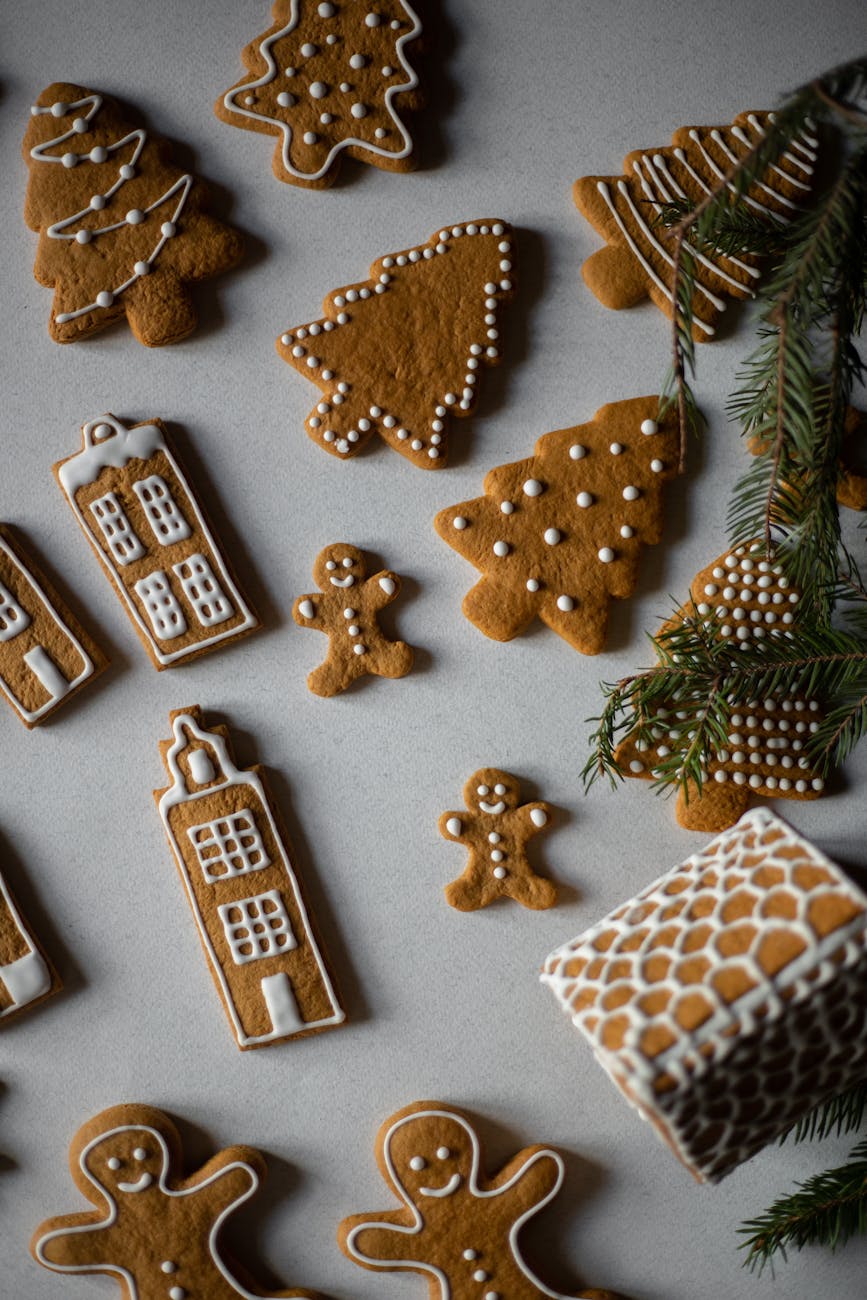
Gingerbread. My inflatable gingerbread man that greets me when I come home each day.
I love the time off.
Telling people Happy Holiday or Merry Christmas or Happy Hannukah, it doesn’t matter, the point is I’m wishing you cheer and you’re wishing me cheer, and there is something kind in that exchange, even with strangers. And because it doesn’t happen all of the time, there is something sacred in this interaction.
I love my Christmas decorations.
The toothy grins of my children’s faces on homemade ornaments from the third grade.
Our family ornaments we collected over the years.
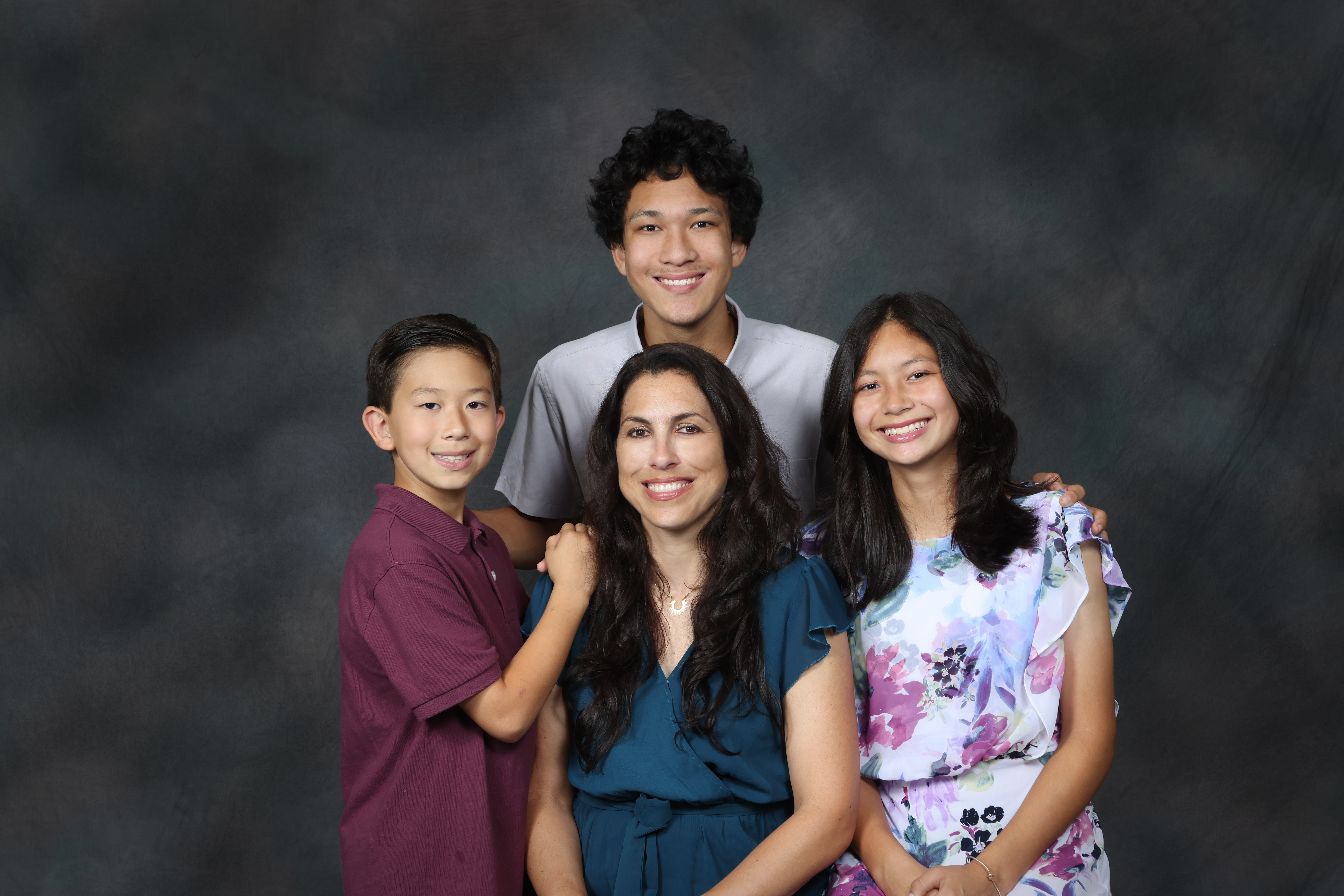
Kenneth, Teresa, Ethan.
Kenneth, Teresa, Ethan, Eloise.
Kenneth, Teresa, Ethan, Eloise, Peter.
Teresa, Ethan, Eloise, Peter.
Life’s fragility in a box of Christmas cheer.
When I pull out the ornaments I got from my grandma—when she decided she was too old to have a tree anymore—I am reminded of impermanence. The coffee filtered angels she made, yellowed with time.
I retired Grandma’s paper angel tree topper that I used to put on my tree for 17 years. Its cardboard wings fell off and rather than fix it, I knew it was time. I replaced it with a cat angel, much more fitting for this chapter of our lives.
There’s also grandma’s clown ornaments with wax faces and velvet clothes and a velvet cone hat. The gold strings used to hang them have snapped, and I decided they were more suitable to display, too fragile to risk hanging on the tree to become the next victim of a midnight cat attack. The ornaments were my great-grandmother’s, over 100 years old. I should display them more safely, guard their age better. But this can be a futile endeavor, like keeping sand from slipping through your fingers. I feel like when it’s their time, we should let them go.
Ethan is learning how to drive. I can not help but think it is representative of being a human and how we live our lives. It doesn’t matter how well you know how to live. It doesn’t matter how great your choices are, how you dot your i’s and cross your t’s. Those things are good. They help. They stack the odds in your favor. But they are not enough. Life will always throw you curve balls.
“Why do you stress so much?” I asked Ethan, frustrated by more of his complaints about having to practice driving again. He normally never stresses. I’m the opposite. I’m always stressed, but when it came to driving, I wanted to drive so bad that I did whatever it took to do it. I don’t remember it stressing me out the way it stresses him out.
“I’m not worried about the driving part,” he explained. “I’m worried about everyone else. People are crazy.”
I’ve taken to narrating my driving whenever he is in the car with me now. As if somehow he will learn by osmosis to predict the erratic behavior we encounter in California gridlock traffic.
“Slow down before you merge in the center. Be careful, you don’t want to slide into oncoming traffic. Watch for cars coming from there, and there, and sometimes they come from over there. They don’t always check for other drivers. Expect them not to check.”
Check here, check there. Signal. Slow down, but not too much because that will trigger impatience from others, and they will try to get around you. Expect this, but also expect that. And also expect everything you haven’t ever conceptualized yet. Follow the rules, but nobody else will. React accordingly.
Geez. No wonder he’s stressed.
“It takes time,” I keep telling him. “Repetition. You have to do it so much that you can do it without thinking about it.”
He groans when I tell him this. He suggests adding a 5th year to high school to delay adulthood.
I am simultaneously in awe of his absolute rejection of speeding up childhood—I couldn’t wait to become an adult—and also feel sorry for him because I know there is no escaping the crushing weight of forward moving time. Being human isn’t easy. Even if it were to come with an instruction manual, there is no book large enough to cover all of the variables and possible scenarios that we encounter. The truth is we all just have to bumble our way through it.
I was up late cleaning and making dough to bake the next morning in the crazy holiday hustle and bustle. I usually do my chores listening to murder mysteries. I realize this sounds like a bizarre source of relaxation to listen to stories about serial killers, but I find myself humbled by the suffering, and also I’m kind of a Nancy Drew and I would love to solve a crime. Anyway, I thought maybe my cortisol levels would benefit from something lighter, so I listened to a Khloe Kardashian podcast episode with her mom, Kris Jenner. They talked about their holiday traditions, and Kris explained the evolution from her hosting the grand Christmas Eve parties at her home, to having to hand over the reins and share hosting with her daughters, letting them have input and control over the vision despite it having always been her big thing that she started with the family. Over the course of the years their wealth skyrocketed and now these holiday gatherings are extravagant displays of overconsumption that we get to watch on television, but it didn’t start that way.
I was thinking about the holidays and some of the lessons we must embrace, whether we are rich Kris Jenner or a peasant like me. Much like learning to drive and being human in general, it is a constant experience of being fully immersed in impermanence. We love tradition and patterns and predictability for our brains, and also life is a million moving parts. It’s new family configurations emerging from the melting pot. It’s a balancing act of letting go and hanging on. Preserving and reinventing. In the end, taking each moment one at a time, whether that be your morning commute and whatever car cuts you off or unexpected construction thwarting your way, or holidays that unfold with new variables.
I was also thinking that there is a Kris Jenner inside that million dollar face life who doesn’t need professional catering and real snow hauled into the event and designer gowns and famous guests. That at the core of her gatherings, it is really about her family getting together. Nothing more.
Which also reminds me about something that resonates with me as I listen to murder mysteries. Many of these cases are from 30 or more years ago. They use familial investigative DNA and tell stories about names that have long been lost in the dustbin of history. Except, they are often not. There are people who carry these lost people into the future. Family members, friends, neighbors. Detectives. The people investigating the mysteries. They have a connection to these people whose bodies have long been put to rest. Many of these people never made it to adulthood, or died in young adulthood. Their stories are tragic, and often their loss changes the trajectories of other people’s lives forever, even when these people are no longer physically here. But they mattered to people. They still matter. I think there is something so beautiful about those invisible ties. You can’t put a price tag on that.
It reminds me that we all need to recalibrate our priorities from time to time. To be more intentional in our interactions with others, less attached to material goods, more heart, less ego, more time. In the end, will people remember the car we drove or the kind of purse we carried, or will it be our conversations, the thoughtful gestures, the way we made them feel?
Ethan turns 16 in a week a half. I told him I had 2 years left of being legally responsible for him, and he bristled at the thought. I remember reading something that said 80% of the time we will ever spend with our children will happen before they are 18. What a sobering thought. It feels like yesterday I took him to the lagoon with a bag full of monster trucks for him to trace across the sand. I remember contemplating what name to call him, debating the theme for his nursery, visiting him twice a day in the NICU for the first 53 days of his life, the day I was discharged from the hospital without a baby in my arms, sobbing the entire car ride home. Pumping milk every 1-2 hours in that first month just to produce enough to fill the tiny bottles that I would drive to the NICU and leave for him. It does not seem possible that all of these years later, he’s closer to adulthood than those early days of his existence.
I remember being very upset that I was one of the parents always alone in the NICU. We had my 6-year-old stepson living with us at the time, and because of the swine flu going around, children were not permitted in the hospital. My husband and I had to take turns visiting. I would sit behind a partition with baby Ethan attached to tubes and pressed against my bare chest for kangaroo care, listening to the other couples on either side of me talking together and silently simmering that I had been abandoned. When I took my CPR training—a requirement for discharge—I was the only person there without their partner. The Samoan couple there with their 13th kid were together, even though the dad looked like he didn’t want to be there. The pretty lady from an affluent neighboring city with her husband. The gay couple adopting a baby. The teenage couple. The smiling woman and her nice husband who rubbed her arm the entire time. And then me, alone, always alone.
In hindsight, I would learn that the NICU experience was training grounds for my life. It was building my resilience. Expectations will be dashed eventually no matter who you are, prepare for the fallout. You will not always have your partner to lean on. Independence is built like a muscle—you have to keep practicing. Practice builds confidence. Scary curveballs will come your way. In the midst of it all, there are a zillion reasons why it was all worth it.
I did not ever in a million years expect to raise Ethan and his siblings alone. That never crossed my mind when I celebrated our first Christmas with him. I remember our last Christmas with my husband. I can still see him on the kitchen floor trying to build an intricate dollhouse for Eloise. I can picture him stepping on the Christmas trash in the trashcan outside, trying to make room for the holiday fallout. I remember visiting his parents in the cemetery. In some ways it still feels unbelievable that tomorrow on Christmas, we’ll spend our 10th one without him, visiting him in that same cemetery, his sister, his parents.
I gave a dharma talk this fall called Empty Seats, Full Hearts. It was about the many people we have lost over the years and the sadness that lingers around the holidays when they aren’t with us at our gatherings. It can be difficult to reconcile those feelings. I miss my grandparents. I miss my friends who have passed away. I miss my husband and my sister-in-law. Our celebrations don’t look the same.
I have to remind myself that the new configurations, the reimagining of traditions, all of the tiny details of right now are just as special as the ones I cherish from the past. They are equally sacred and important. There is more joy.
Most importantly, today I get to spend the holiday with my kids. There is not better gift. On Christmas day we’ll have a slow morning opening presents and digging into the stockings hanging over the fireplace. I’ll make them breakfast while they explore new toys and gadgets. We’ll have our traditional potato soup and sticky toffee pudding for dessert. I will play one last day of Bing Crosby Christmas songs and light a gingerbread candle. A million ways to experience joy in a story that doesn’t always unfold the way we plan, but was still worth living.
I hope wherever you are, whatever you are doing, it is exactly how you need to celebrate the holidays this year. That you find joy. That you spread joy in whatever big or small way that you can. That you know your existence matters to others, and that in any given moment we are all rich in the invisible currency that gives us purpose and connects us to each other in this messy human existence we still get to experience. It’s a wild ride. Learn the rules, and know that everyone else won’t follow them. You’ll find your way. It is so worth it.


 Teresa Shimogawa
How beautiful this is. Thank you and wishing you a lovely Christmas.
LikeLike
Thank you for reading. Happy New Year!
LikeLike
Just lovely. Thank you for such a powerful Christmas message. And your family is growing up – you all look healthy and strong. Merry Christmas and all the best to you for 2026. Janice
LikeLike
Thank you for reading. I appreciate your comment. Happy New Year!
LikeLike
Blessed holidays to you and your beautiful family
LikeLike
Thank you. Happy New Year!
LikeLike
Happy Holidays to you and your family. I am in awe of your writing and the ability to so clearly put feelings and thoughts into words. Loved this one!
LikeLike
Thank you for reading! Happy New Year.
LikeLike
I love watching your beautiful family grow up — thank you for sharing it with us. I hope one day, you’ll compile these writings into a book!
LikeLike
Aww, thank you! Happy New Year!
LikeLike
I love watching your beautiful family grow — thank you for sharing it with us. I hope one day you’ll compile your essays into a book. You’re an incredible writer and I look forward to your posts.
LikeLike